Getting Started with Visual Schedulers: What the Research Says and Why They Work
By Keith Gutierrez
If your child is neurodivergent, you've almost certainly heard a therapist, teacher, or pediatrician say something like: "You should try a visual schedule." Maybe you nodded along, Googled it later, and found yourself staring at a wall of laminated cards, Velcro strips, and apps, unsure where to begin.
You're not alone. Visual schedules are one of the most frequently recommended tools for neurodivergent children, and for good reason. But between the clinical jargon and the sheer number of options, getting started can feel overwhelming.
This article is here to change that. We'll walk through what visual schedules actually are, what the research says about why they work, and how to start using one with your child. Today, not someday.
What Is a Visual Schedule?
A visual schedule is a tool that uses images, photographs, icons, or words to show a sequence of events or activities. Instead of relying on verbal instructions ("First we're going to the store, then we'll go home, then it's bath time"), a visual schedule lays out the plan in a way your child can see, touch, and reference on their own.
Think of it like this: most adults use some form of visual scheduling already. Your phone's calendar, a to-do list on the fridge, a whiteboard at work. These are all visual schedules. We rely on them because seeing a plan is easier than holding it in our heads. The same principle applies to children, especially those who process visual information more readily than spoken language.
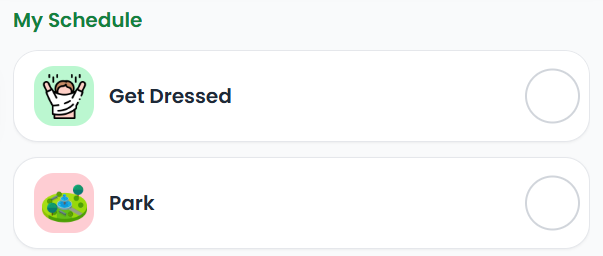
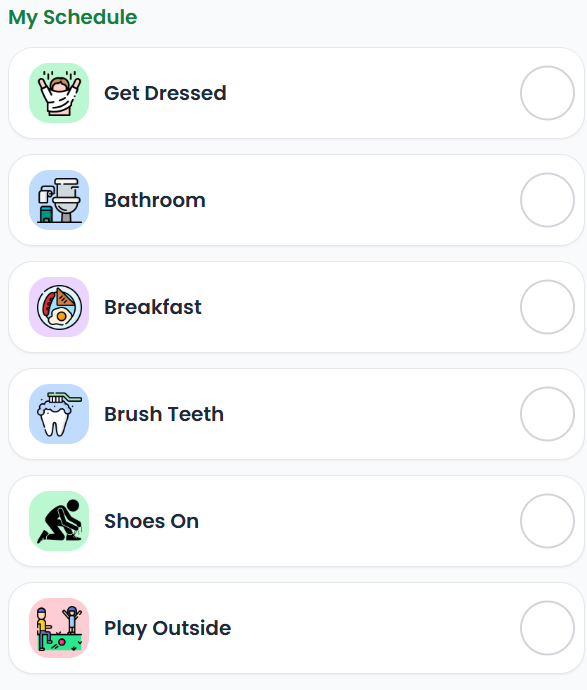
Visual schedules can be as simple as two pictures on a card ("first this, then that") or as detailed as a full day mapped out activity by activity. The format depends entirely on your child's needs and developmental level.
For example, first we'll get dressed, then we'll go to the park:
Or it can be a full day:
Why Visual Schedules Work: What the Research Tells Us
Visual schedules aren't just a popular suggestion. They're one of the most well-studied tools in the field. The National Clearinghouse on Autism Evidence and Practice, housed at the Frank Porter Graham Child Development Institute at UNC, has recognized visual schedules as one of 28 evidence-based practices for supporting autistic individuals. That designation is backed by decades of peer-reviewed research.
Here's what the research consistently shows:
They Create Predictability
Many neurodivergent children have a strong need for predictability. When routines feel unpredictable, anxiety goes up, and with it, challenging behaviors. Visual schedules address this directly by showing your child what's happening now and what's coming next. Research from Indiana University's Indiana Resource Center for Autism has found that visual schedules help individuals view upcoming activities, understand the sequence of events, and increase overall predictability in their day.
They Reduce Transition Anxiety
Transitions, the moments between activities, are often the hardest part of the day for neurodivergent children. Studies have estimated that up to 25% of a typical school day is spent in transition activities like moving between classrooms, coming in from recess, or gathering materials. For a child who struggles with shifting attention or tolerating disruptions to their routine, that's a lot of potential stress points.
Visual schedules give children advance notice of what's coming. When a child can look at their schedule and see that "playground" is followed by "lunch," the transition becomes less of a surprise and more of an expected shift. Research has shown that using visual cues during transitions can decrease challenging behavior and increase the child's ability to follow transition demands.
They Support Executive Functioning
Executive functioning includes skills like planning, organizing, sequencing, and managing time. These are areas where many neurodivergent children need support. Visual schedules act as an external scaffold for these internal processes. A 2024 literature review published in the International Journal of Developmental Disabilities found that visual schedules help individuals with autism overcome difficulties with planning, organizing, and sequencing multiple pieces of information, which directly supports task engagement and independent completion of activities.
They Build Independence
One of the most powerful benefits of visual schedules is that they reduce reliance on adult prompting. Once a child learns to follow their schedule, they can navigate activities with less verbal direction. Researchers have used visual schedules to increase on-task behavior, facilitate independent transitions, improve daily living skills, and even promote social interactions, all while gradually reducing the level of adult support needed.
An Important Nuance
No tool is a silver bullet, and the research is honest about that. One study published in the Journal of Applied Behavior Analysis found that visual schedules alone were not always sufficient to reduce problem behavior during transitions from preferred to nonpreferred activities. In other words, if your child is deeply engaged in something they love and the schedule says it's time to stop, the schedule alone may not prevent a tough moment.
What the research does show is that visual schedules work best when they're paired with other strategies: reinforcement for following the schedule, verbal warnings before transitions, consistency across environments, and patience as your child learns the routine. The schedule is the foundation, and the other strategies build on top of it.
How to Get Started
The best visual schedule is one you'll actually use. Here's how to start small and build from there:
1. Pick One Routine
Don't try to schedule the entire day on your first attempt. Choose a single routine that's consistently challenging, like the morning getting-ready sequence, the after-school transition, or the bedtime routine. Starting with one routine lets you and your child learn the system without feeling overwhelmed.
2. Keep It Short
For new users, a schedule with three to five steps is plenty. You can always add more later. Research supports starting with a simple "first-then" format (just two items) for children who are brand new to visual supports.
3. Use Visuals That Make Sense to Your Child
Some children respond best to photographs. Others do well with icons or simple illustrations. Some older children prefer words. The key is choosing visuals that your child can clearly understand and connect to the real activity. There's no single right format.
4. Build in a "Finished" Step
Give your child a way to mark each activity as done. This might mean moving a card to a "finished" pocket, flipping it over, or checking it off on a screen. That physical or digital act of marking completion reinforces the sense of progress and signals readiness for what's next.

5. Be Consistent
Use the schedule at the same time, in the same way, every day. Consistency is what builds the habit. Over time, your child will begin checking the schedule independently, and that's the goal.
Ready to Try It?
SpeakMyWay's Visual Scheduler is a free, digital tool built specifically to make this easier. You can create a visual schedule in minutes, customize it with images and labels that work for your child, and check off activities as you go. No laminating, no Velcro, no lost cards.
Try the Visual Scheduler free at schedule.speakmyway.com
You don't need to be a therapist to use a visual schedule effectively. You just need a starting point, and now you have one.
Sources & Further Reading
- Hume, K. et al. (2021). Evidence-Based Practices for Children, Youth, and Young Adults with Autism. National Clearinghouse on Autism Evidence and Practice, Frank Porter Graham Child Development Institute, UNC. https://ncaep.fpg.unc.edu/
- Liang, Z. et al. (2024). The use of visual schedules to increase academic-related on-task behaviors of individuals with autism: a literature review. International Journal of Developmental Disabilities. https://www.tandfonline.com/doi/full/10.1080/20473869.2024.2402124
- Waters, H. et al. (2009). Visual schedules and transitions. Referenced in: Transition Time: Helping Individuals on the Autism Spectrum Move Successfully. Indiana Resource Center for Autism, Indiana University. https://iidc.indiana.edu/irca/articles/transition-time-helping-individuals-on-the-autism-spectrum-move-successfully-from-one-activity-to-another.html
- Schmit, J., Alper, S., Raschke, D., & Ryndak, D. (2000). Effects of using a photographic cueing package during routine school transitions with a child who has autism. Mental Retardation, 38(2), 131-137.
- Waters, M. B., Lerman, D. C., & Hovanetz, A. N. (2009). Separate and combined effects of visual schedules and extinction plus differential reinforcement on problem behavior. Journal of Applied Behavior Analysis, 42(2), 309-313. https://pmc.ncbi.nlm.nih.gov/articles/PMC2695333/
- Knight, V., Sartini, E., & Spriggs, A. D. (2015). Evaluating Visual Activity Schedules as Evidence-Based Practice for Individuals with ASD. Journal of Autism and Developmental Disorders, 45(1), 157-178. https://link.springer.com/article/10.1007/s10803-014-2201-z
- Links ABA (2025). Visual Schedules for Children with Autism. https://linksaba.com/visual-schedules-for-children-with-autism/
- Life Skills Advocate (2025). Customizing Visual Schedules for Every Learner. https://lifeskillsadvocate.com/blog/customizing-visual-schedules-for-every-learner/